

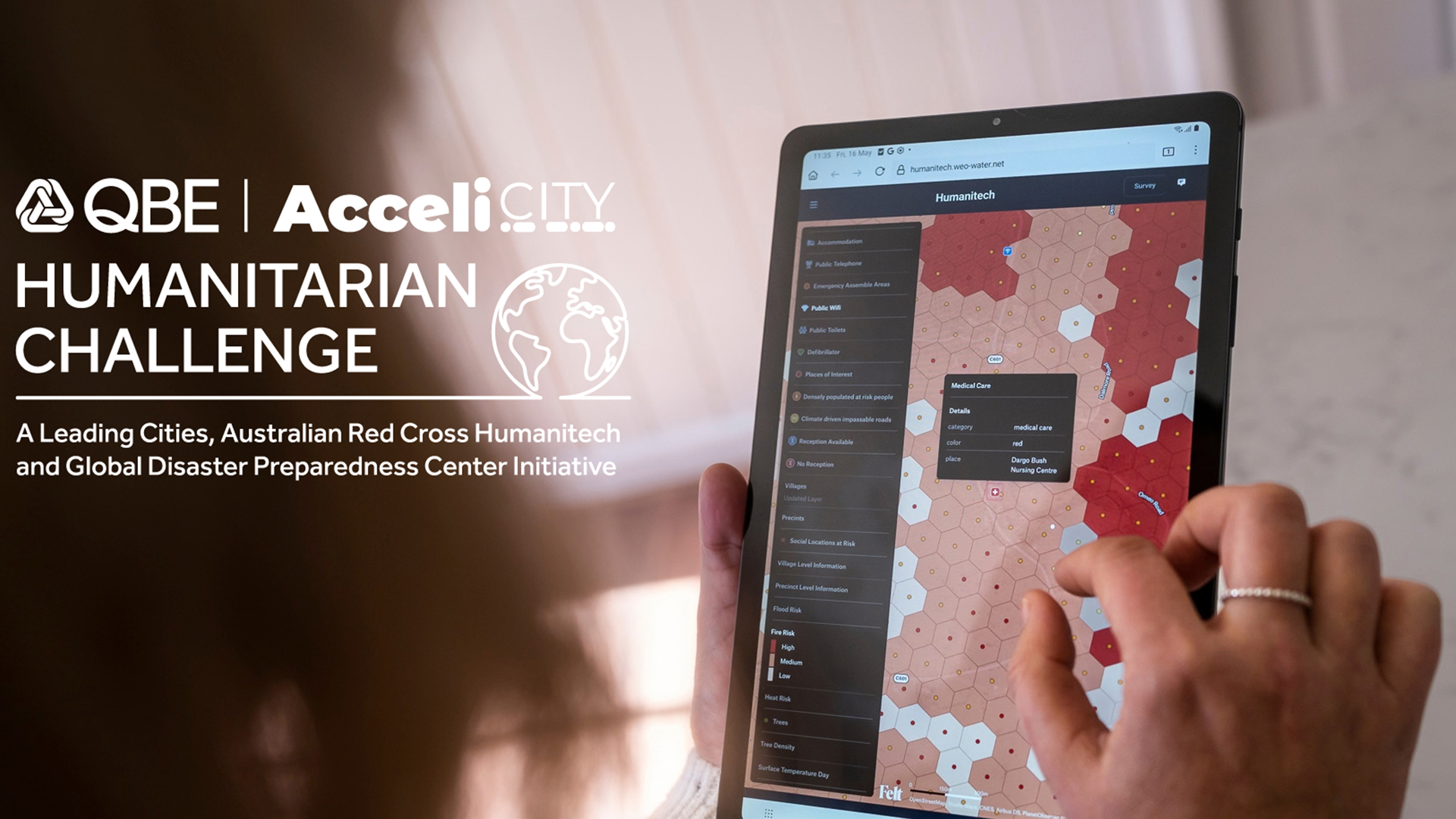
As climate and disaster risks become more frequent and complex, communities need new ways to prepare, adapt and recover.
At the same time, startups are developing innovative technologies, products and services with the potential to make a meaningful difference. Too often, however, promising solutions struggle to move beyond early adoption. Without access to trusted partners, opportunities to test in real-world environments and pathways for growth, promising solutions can struggle to reach the communities they were designed to serve.
Leading Cities built the AcceliCITY program to bridge that gap. The QBE AcceliCITY Humanitarian Challenge brings Leading Cities’ AcceliCITY infrastructure and two decades of civic innovation practice into partnership with Australian Red Cross, the Global Disaster Preparedness Center and QBE Foundation, with a focus on humanitarian issues.
Rather than simply identifying innovative ideas, the Humanitarian Challenge is designed to ensure promising solutions are adopted, trusted and embedded in communities, particularly those most at risk from climate-related disasters.
Through Leading Cities’ AcceliCITY platform, a global network of 16,000+ cities, startups gain a proven, structured pathway for acceleration, vetting and deployment. Within that pathway, Australian Red Cross and the Global Disaster Preparedness Center connect startups with humanitarian expertise, community insight and opportunities to test solutions in community settings.
Through the global Red Cross Red Crescent Movement, startups also gain access to one of the world’s largest humanitarian networks, creating opportunities to co-design, test, adapt and scale solutions across diverse communities and contexts.
Because solving complex humanitarian challenges isn’t just about generating new ideas. It’s about helping the right solutions reach the right communities and creating the conditions for them to grow.
Winning startups receive funded pilot opportunities with Red Cross Red Crescent Movement partners, valued at up to AUD $100,000, turning ideas with potential into solutions with evidence, credibility and momentum.
Each year, the Challenge focuses on priority humanitarian and resilience challenges identified by Red Cross Red Crescent Movement partners.
Startups have the opportunity to test their solutions against real-world challenges, generating insights that extend beyond a single community, location or pilot. What starts as a local pilot can become a model for impact in communities around the world.
For the 2027 Challenge, we’re seeking startups with existing products, technologies or services that can help address the following humanitarian and resilience challenges.
The Humanitarian Challenge is designed for innovators ready to validate and scale their solutions. More than an innovation challenge, the Challenge provides a structured pathway for humanitarian organisations and communities to identify, assess and adopt technology-enabled solutions that address real-world challenges.
Participants gain access to:
Winning startups receive funded pilot opportunities with Red Cross Red Crescent Movement partners, valued at up to AUD $100,000, turning ideas with potential into solutions with evidence, credibility and momentum.
Since 2018, Leading Cities and QBE have selected startups from 75 countries through AcceliCITY. AcceliCITY alumni have raised over US$3.3 billion in funding to date.
The program has also sourced more than 60,000 solutions, evaluated over 6,000 and educated more than 600 startups working to strengthen community resilience and sustainability.
Now in its third year, the Humanitarian Challenge has supported three pilots with Red Cross Red Crescent Movement partners across Australia and Indonesia.
The Challenge continues to demonstrate how community insight, humanitarian expertise and innovation can come together to strengthen resilience and support community-led outcomes.
Explore how a previous Humanitarian Challenge winner has worked with Red Cross partners to test, refine and scale its solution in real-world settings: WEO: When a map becomes a mirror.
The QBE AcceliCITY Humanitarian Challenge is a unique cross-sector collaboration between Leading Cities, QBE Foundation, the Global Disaster Preparedness Center and Australian Red Cross, focused on scaling community-led solutions for climate resilience since 2024.
This Challenge brings together three organisations with distinct strengths:
Together, the partnership creates a credible pathway from innovation to community adoption.

Join a global community of innovators working to solve pressing humanitarian challenges and help build stronger, safer and more resilient communities. Subscribe for updates or follow us on LinkedIn to see how bold ideas grow into community-ready solutions.